- By flightdispatchtraining
- November 2, 2026
- Comments (0)
Here’s something most passengers never find out. Two people sign off on an airline flight in Canada. One’s the captain. The other’s a dispatcher, probably in an ops room miles away, who just spent an hour on weather, fuel and backup airports.
Outside aviation, hardly anyone’s heard of this job. Kind of a shame, really. If you’re into airplanes but not into flying them, the flight dispatcher career path might be exactly your thing.
What Does Flight Dispatcher Career Progression Look Like in Canada Today?
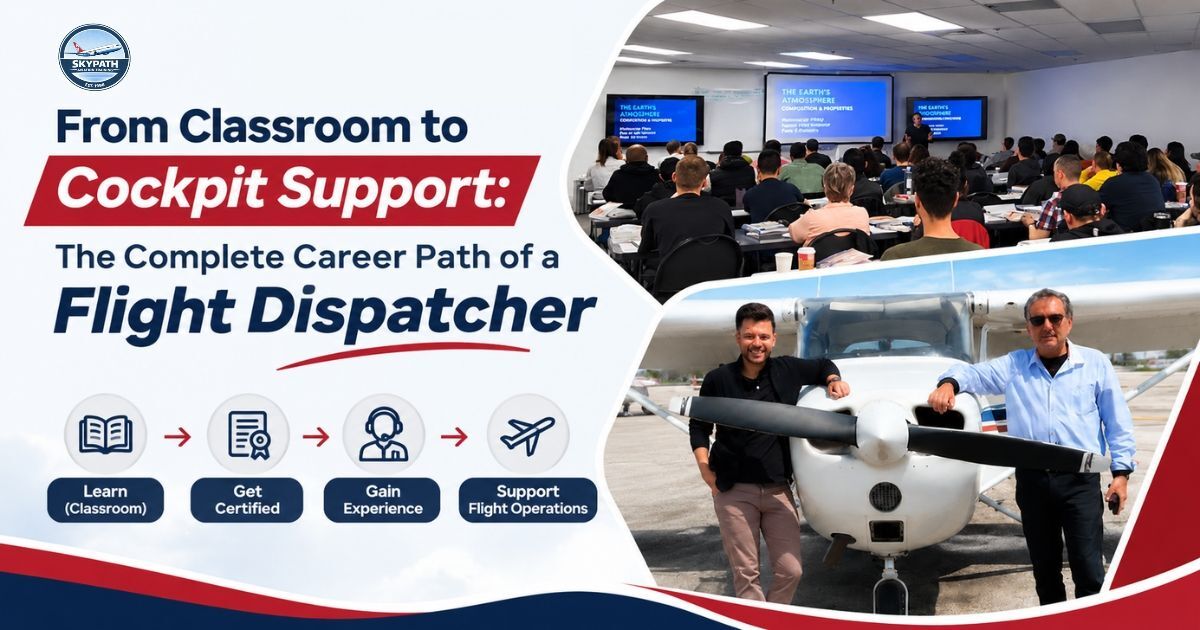
Pass FDOPS and FDMET, the two Transport Canada exams. Get your ROC-A radio certificate. Then an airline hires you as a dispatcher in training and certifies you once you’re ready. After that, the flight dispatcher career path leads to senior dispatch, check dispatcher and, eventually, management.
Step One: Classroom Training and Transport Canada Exams
The flight dispatcher career path usually kicks off in a classroom with a pile of weather charts. FDOPS covers the regs, flight planning and aircraft performance. FDMET is weather, and a lot of it.
Nobody asks for a degree. Our students are often surprised by that one.
Still, study hard. Both exams are closed books. Oh, and sort out the ROC-A early, since nearly every Canadian job ad we’ve seen asks for it.
Step Two: Landing Airline Operations Jobs as a Dispatcher in Training
So you passed. Can you start dispatching? Not yet.
Section 705.110 of the Canadian Aviation Regulations says you can’t dispatch for an airline until you’ve done that airline’s training and hold a flight dispatcher certificate. Which means your next move is applying for airline operations jobs called “dispatcher in training.”
We check these postings a lot, and they barely change. You’ve got to be 21 or older, with an ROC-A and FDOPS and FDMET results that are still valid. Most ads read “valid” as written in the last two years.
The airline pays for your training. At the end, a check dispatcher sits next to you for a shift and signs you off. That’s when the flight dispatcher career path gets real.
Where a Flight Operations Career Can Take You?
You don’t have to work for Air Canada or WestJet. According to the Job Bank, dispatchers also work for air services companies and the Canadian Forces. Charter, cargo and medevac operators hire them too.
Some grads don’t land a dispatch desk on day one. They start in crew scheduling, flight following or SOC instead, since the knowledge overlaps. That’s a big plus of a flight operations career. It’s also, honestly, why we rate dispatch so well among aviation career options.
Dispatcher Career Growth: From First Shift to Operations Leadership
Year one is domestic flights on a single fleet. And coffee, lots of it.
Stick around and the flight dispatcher career path opens up. International desks are one option. Check dispatcher is another, and Transport Canada’s manual wants two years of experience before you get there. Managers come after that. One Air Canada dispatch manager asked for five years plus.
Dispatcher career growth is slow-ish, no question. The good part is you always know what’s next.
As for pay, Job Bank’s national median is $54.88 an hour for 2024. Keep in mind that number also counts air traffic controllers, so starting pay is usually lower.
Your Flight Release Is Waiting
Lots of aviation people never touch the controls. They’re on the phone with a flight deck at 3 a.m., finding a way around a storm.
If that sounds like your kind of job, the flight dispatcher career path is open to you, and Flight Dispatch Training can help you start. Our instructors teach an intensive in-person course in Markham, Ontario, covering FDOPS, FDMET and radio certification. Have a look at the course details and pick an intake.
FAQs
1. How long does it take to become a flight dispatcher in Canada?
Our course itself is one busy week. Then you’ll do some extra studying and write the Transport Canada exams. Once an airline hires you as a dispatcher in training, their program usually lasts a few weeks to a few months.
2. Do I need a degree or pilot license to become a flight dispatcher?
No to both. What you need is passing FDOPS and FDMET results, an ROC-A and an airline’s approved training. Honestly, that’s what makes it one of the easier aviation career options for people switching jobs in their thirties or forties.
3. What do flight dispatchers do on a typical shift?
They plan routes, figure out fuel and go through the weather and NOTAMs. Then they release each flight with the captain. While planes fly, dispatchers keep watching and help crews deal with delays, diversions or mechanical problems along the way.
4. Is flight dispatch a good long-term career choice?
Yes, if you really like responsibility. You can work up to senior dispatcher, check dispatcher, SOC or management, so dispatcher career growth is there for people who stay. Pay normally rises with seniority and with how big your airline is.
5. Which employers hire flight dispatchers in Canada?
Airlines, both national and regional, hire the most. Charter companies, cargo carriers, air ambulance operators and the Canadian Forces hire dispatchers as well. Related airline operations jobs like crew scheduling or SOC support can get your foot in the door.